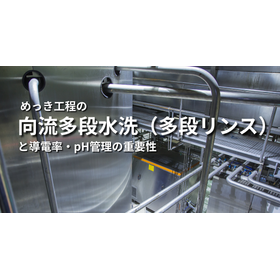
The importance of counterflow multi-stage rinsing in the plating process and the management of conductivity and pH.
We will also introduce practical tips for on-site operations and water usage reduction (HI 520 usage examples)!
In Japanese plating factories (such as nickel, zinc, and chrome), compliance with wastewater standards based on the Water Pollution Prevention Act is required, and in recent years, reducing water usage and wastewater load has become important from both environmental and cost perspectives. Against this backdrop, counterflow multi-stage rinsing (counterflow cleaning/multi-stage rinsing) has been widely adopted as it can achieve both cleaning efficiency and water conservation. Counterflow multi-stage rinsing involves connecting multiple rinse tanks in series, where new water introduced into the last tank flows sequentially to the preceding stages. This mechanism ensures that parts are cleaned with the most purified water at the end of the process. As a result, it can significantly reduce water usage and wastewater volume while maintaining equivalent cleaning quality compared to traditional single rinsing or continuous spraying methods. *For more detailed information, please refer to the related links. Feel free to contact us for further inquiries.
- 企業:ハンナインスツルメンツ・ジャパン
- 価格:Other
